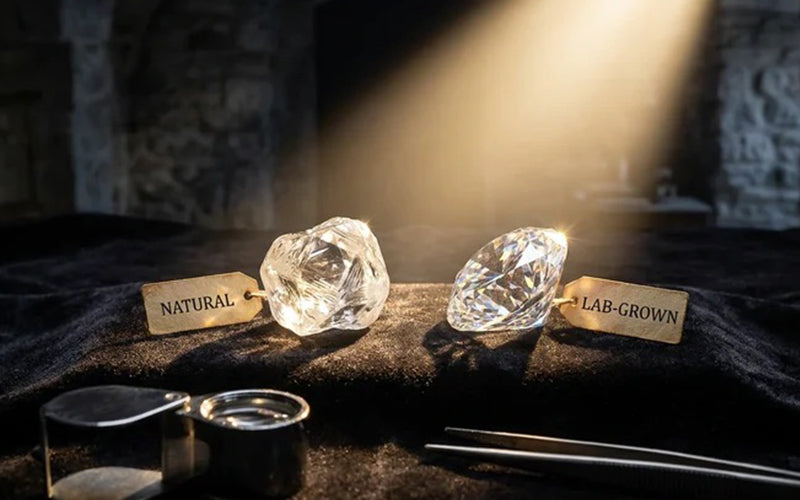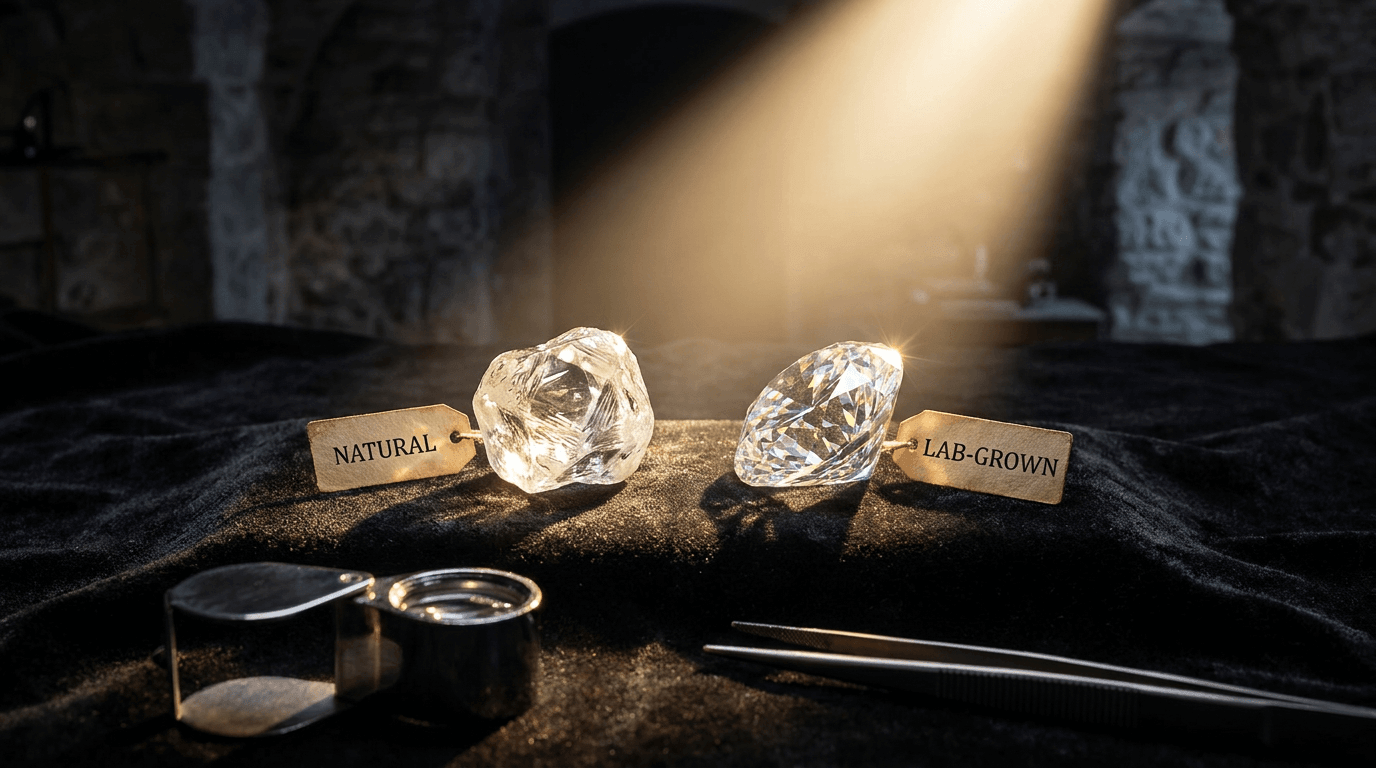

The question we hear most often at our Woodbridge and Yorkville boutiques is no longer about the 4Cs. It is simpler and harder to answer: should I buy a lab-grown diamond or a natural one? In 2026, with lab-grown diamonds now appearing in over 60% of engagement rings across North America, this is the defining choice for any serious diamond buyer. And yet most of what you read online is written by companies that only sell one type. At BANDIERA JEWELLERS, we carry both natural diamonds and lab-grown diamonds because we believe our clients deserve honest options, not a predetermined answer.
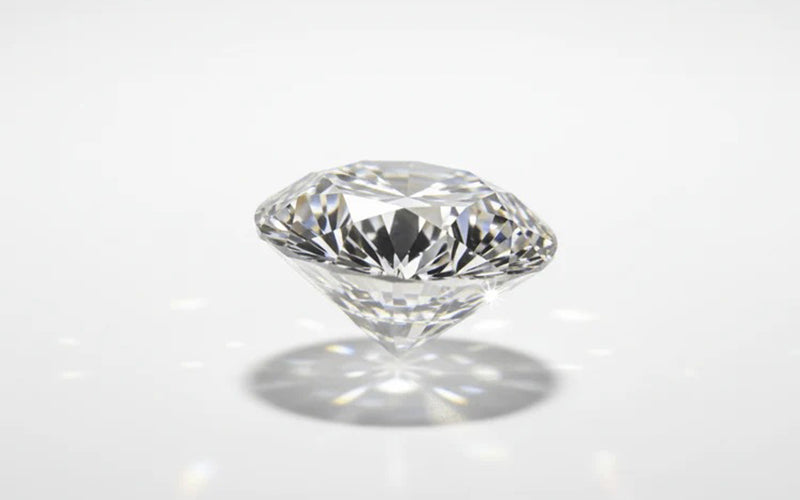
Natural diamonds: geological artifacts formed 1 to 3 billion years ago, over 150 kilometres below the earth’s surface.
Let’s start with what should not be in dispute. Lab-grown diamonds and natural diamonds are chemically, physically, and optically identical. Both are pure crystallized carbon. Both score a perfect 10 on the Mohs Hardness Scale. Both refract light with the same brilliance, fire, and scintillation. If you placed a lab-grown diamond and a natural diamond of the same 4C grades side by side, no jeweller on earth could tell them apart with the naked eye. Origin can only be confirmed using specialized laboratory equipment. This is not a question of real versus fake. Both are real diamonds.
Price. This is the most dramatic difference. A one-carat lab-grown diamond with D to F colour and VS clarity retails for roughly $500 to $1,500 in 2026. A comparable natural diamond sits between $4,500 and $10,000. Lab-grown prices have fallen approximately 85 to 90 percent since 2020 as global production capacity expanded by over 300 percent. That free-fall has largely stabilized, but the price gap is now enormous and unlikely to close.
Resale value. This is where the conversation gets uncomfortable. Natural diamonds typically retain 30 to 60 percent of their retail price on the secondary market. Lab-grown diamonds currently retain only 10 to 30 percent, and some dealers will not buy them back at all. The reason is straightforward: natural diamonds are constrained by geological scarcity, while lab-grown stones can be produced in unlimited quantities. As production technology continues to improve, older lab-grown diamonds lose market value in the same way last year’s electronics do.
Meaning and legacy. This is personal, not financial. For some buyers, the fact that a natural diamond took billions of years to form and survived a journey from 150-250 kilometres below the earth’s surface carries profound significance. It is a geological artifact, a one-of-one piece of the planet’s history. For others, the ability to choose a larger, flawless stone without the ethical complexities of mining carries its own meaning. Neither perspective is wrong.
Choose natural if the diamond is an heirloom piece you intend to pass down, if geological rarity and tradition are meaningful to you, if resale flexibility matters, or if your partner has a strong preference for a mined stone. Natural diamonds align with the idea of a “forever” purchase in both the emotional and financial sense.
Choose lab-grown if you want to maximize size and visual impact within your budget, if you plan to keep the piece forever and resale is irrelevant, if ethical sourcing is a priority, or if you want a stunning fashion piece or right-hand ring without the premium price. A budget that once bought a modest one-carat natural stone can now comfortably afford a two to three-carats lab-grown diamond.
We do not push one over the other. We ask questions instead. What does this diamond represent to you? Do you see it as a financial asset or a symbol of a moment? Will you ever want to trade it in or upgrade? Are you drawn to the story of geological rarity or the story of modern innovation? The answers to those questions matter far more than any price chart.

Whether you are leaning toward a natural diamond with billions of years of history behind it or a lab-grown stone that lets you dream bigger within your budget, the team at BANDIERA JEWELLERS can guide you through the details in person. Browse our natural diamond and lab-grown diamond collections online, or visit our boutiques in Woodbridge and Yorkville to see the difference that cut quality makes when you hold both options side by side.
Comments will be approved before showing up.